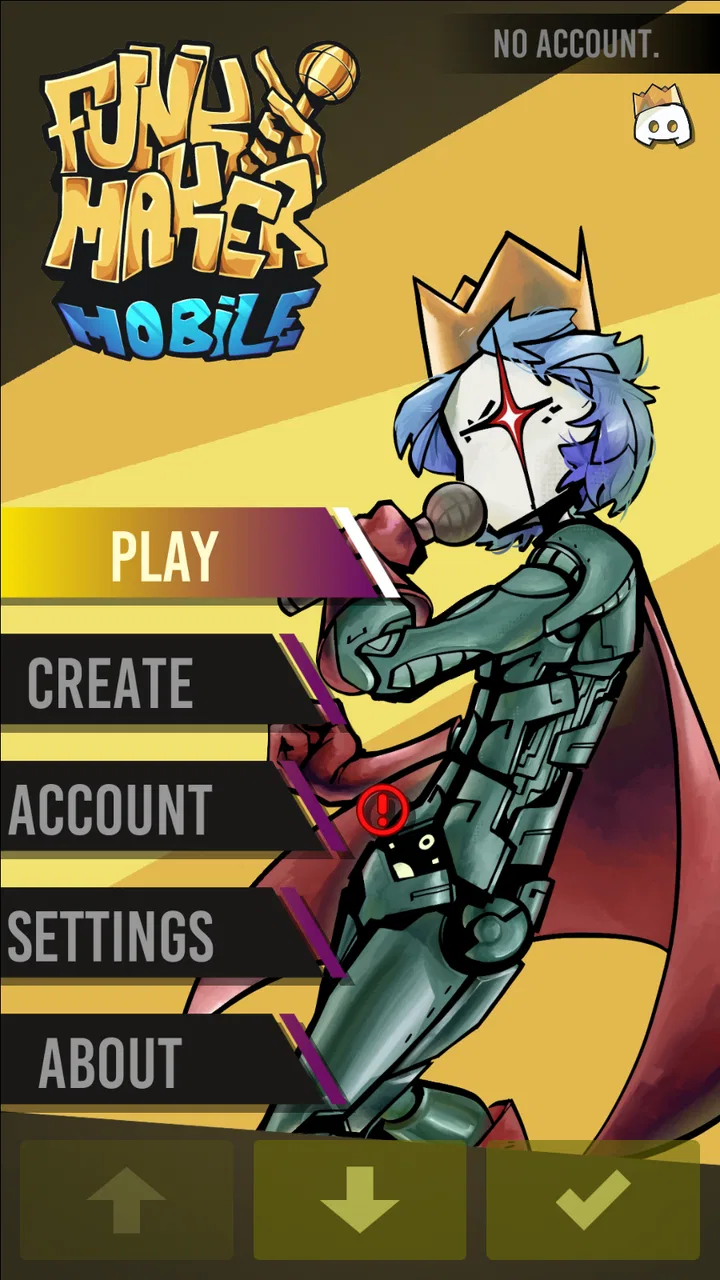
Funky Maker: Mobile!
- 4.1
- Rating
- 500.00K
- Installs
- Free
- Price

 Analysis by App-foxy
Funky Maker: Mobile! caught my attention because it takes a very simple idea—pressing buttons in time with music—and tries to turn that action into the whole personality of the game. I found it easy to understand within moments, but the appeal is not only in knowing what to do. The real question is whether the rhythm, visual style, and pacing make repeated button presses feel satisfying rather than routine. In my experience, this game works best when I treat it as a short musical break, not as a deep replacement for a full rhythm-game library.
It is a free music game from KinGamesCreator, rated for Everyone, with more than half a million installs and an average score of 3.9 from roughly four thousand ratings. Those figures suggest a game with a reasonably broad audience, while the rating also hints at a mixed experience: plenty of players can enjoy the straightforward concept, but not everyone will find enough depth or polish to stay for a long session. That balance became clear to me as I spent time with its presentation and its central timing-based interaction.
A bright musical mood built around simple actions
I find the game’s appeal rests on how quickly it gives a musical moment a clear purpose: listen, follow the beat, and press at the right time. That directness makes it easy to try without treating it as a commitment, but it also puts extra weight on focus and timing. In the sections ahead, I’ll look at what makes that simple loop inviting and where its limits become noticeable.
You May Also Like

 Blood Strike: 2.5 Anniversary
Blood Strike’s Loadouts Turn Every Drop Into a Tactical Gamble
A close look at Blood Strike’s custom loadouts: how fast access to signature weapons reshapes its battle royale rhythm, rewards preparation, and narrows the gap between fights.

 Pandora - Music & Podcasts
Pandora’s Music Is Easy to Start, but Harder to Recover
Pandora’s strength is its low-effort path from a seed to a station. Its weak spot is how much confidence it asks you to place in connection, setup, and quiet recovery.

 8 Ball Pool
 Is Built on Rivalries, Rematches, and Routine
A close look at the rivalries, rematches, shared routines, and unanswered safety questions that turn a quick pool match into a persistent mobile community.

 Samsung Music
’s Quiet Strength Is Playing What You Already Own
Its reach comes less from spectacle than from dependable access to a personal library. That simplicity is both the app’s strongest retention engine and its ceiling.

 AccuWeather: Weather Radar
AccuWeather Review: A Quick, Clear Forecast for Everyday Decisions
For everyday plans, the best forecast is the one you can understand quickly. AccuWeather makes rain timing, radar, and local conditions easy to act on, with a few trade-offs.

 Hill Climb Racing
Why Hill Climb Racing Still Turns Crashes Into One More Run
A tiny car, a bumpy hill and one more upgrade: Hill Climb Racing keeps resurfacing because its simple chaos makes every near-miss feel personal.
More From Our News Desk
View All News


The first few minutes are immediately readable
The strongest part of the opening is its clarity. The game presents itself as a rhythm-focused button-pressing experience, so there is little uncertainty about the basic relationship between what appears on screen and what I am expected to do. That makes it approachable for someone who does not usually play music games. I did not need to learn a complicated control scheme before understanding the intended flow.
That simplicity is also the first important trade-off. A game built around one main type of action has to create variety through timing, presentation, song flow, and the feeling of improvement. If those supporting elements do not keep changing, the core interaction can begin to feel repetitive. I would therefore recommend trying it with the expectation of quick, focused sessions rather than assuming that its uncomplicated controls automatically mean unlimited replay value.
The free entry point helps. I can install it and decide whether its particular sense of rhythm suits me without paying upfront. The game does include optional purchases ranging from $1.99 to $19.99 per item, so I would approach those carefully and first decide whether the basic experience already gives me the kind of musical engagement I want. For a casual player, the no-cost starting point is the main attraction; for a committed rhythm fan, the purchase structure becomes part of the decision.
Its visual language supports the playful tone
Funky Maker: Mobile! presents itself with a deliberately lively identity. Even the short name “Funky Maker” points toward something colorful, energetic, and a little playful rather than a serious simulation of musicianship. I read the art direction as an invitation to relax into the beat. The game does not need a realistic stage or a detailed narrative world to establish its mood; its job is to make the screen feel like a place where timing and musical movement belong together.
That approach matters because rhythm games can easily become sterile. When the screen is treated only as a lane for inputs, the player may focus on accuracy while feeling disconnected from the music. Here, the visual presentation helps frame the button presses as part of a small performance. I found that this made short sessions feel more intentional: I was not merely tapping a sequence, but responding to a visual and audio prompt that had a recognizable personality.
The art direction is most effective when it stays subordinate to readability. In a rhythm game, decoration should add energy without obscuring the moment when an input needs to happen. This creates a useful test for the player: if the visual style makes the beat easier to feel, it is doing its job; if it pulls attention away from timing, the same style becomes a distraction. I would suggest starting with a calm environment and judging the game by how comfortably the visual effects coexist with the rhythm, rather than by screenshots alone.
A world without heavy story can still feel coherent
This is not the kind of game I play for character development or a long narrative arc. Its “world” is better understood as a consistent musical playground. The setting is communicated through color, movement, sound, and the upbeat attitude of the presentation. That is enough for the short-session format, because the game’s identity comes from the way these elements reinforce the central action.
I appreciate that the setting does not appear to compete with the music. A story-heavy structure would raise expectations for exploration, dialogue, and progression, while this game is more comfortable keeping the focus on immediate interaction. The result is modest but coherent: the screen, the sound, and the button presses all point in the same direction. Players who need a strong fictional setting may find it lightweight, but those who want a quick musical activity are less likely to feel burdened by unnecessary narrative.
One useful way to approach it is as a mood tool. I can imagine opening it while waiting for an appointment, taking a short break between tasks, or giving a younger player an accessible music-themed game to try. Its Everyone rating supports that broad accessibility, although an adult who wants demanding progression may outgrow the simple presentation sooner than a casual player will.
The sound is the reason to stay
Because the interaction is so direct, the audio has to carry much of the game’s personality. In my experience, the rhythm is not just background decoration; it is the signal that tells me when the game feels alive. A successful input should feel connected to the beat, and a missed moment should make me aware that my timing has slipped. That relationship is what turns a button press into a musical action.
The game’s funky identity also depends on the sound feeling buoyant rather than mechanical. When the audio and visual cues line up, the experience becomes pleasantly physical: I start anticipating the next beat instead of merely reacting to a symbol. This is a small distinction, but it is important. A purely reactive game can feel like a test, while a well-paced rhythm sequence can feel like participation.
I would play with sound enabled whenever possible. Without audio, the game loses much of the information that gives its timing a sense of purpose. This is one of the clearest practical tips I can offer: if a sequence feels flat or harder than expected, check the listening environment before deciding that the controls are the problem. A noisy room, low volume, or divided attention can make a rhythm game feel less responsive even when the main issue is that the beat is difficult to hear.
Pacing decides whether the simplicity works
The pacing is more important here than in a conventional action game. There is no need for long travel sections or elaborate downtime; the pleasure comes from moving cleanly from one musical moment to the next. I found the best sessions were the ones where I could settle into the tempo quickly and make several attempts without feeling that the game was wasting my time.
At the same time, a short, repetitive structure can expose weak pacing immediately. If the game gives me too little variation between attempts, I notice the pattern rather than the music. That is where personal preference matters. Some players will enjoy the comfort of a familiar rhythm and the chance to improve their timing. Others will want constantly changing challenges, more elaborate progression, or a wider range of musical styles, and may prefer a larger rhythm title instead.
My advice is to judge the pacing over several brief sessions rather than one long sitting. A game like this can be enjoyable for five minutes and tiring after half an hour, or it can become more satisfying once the basic timing starts to feel natural. The right use is often to stop while the mood is still fresh. That keeps the game’s compact design working in its favor instead of turning its repetition into a chore.
How the mechanics fit the presentation
The central mechanic and the presentation are well matched because neither asks the player to manage too many unrelated tasks. The button presses keep my attention on timing, while the visual and musical layers provide feedback about the quality of that timing. This is a sensible design choice for a mobile game: I can begin quickly, use a familiar touch interaction, and focus on the beat instead of learning a large set of commands.
The downside is that the mechanical ceiling may feel limited to players who expect a broad skill system. A more complex rhythm game might offer multiple input types, demanding patterns, long-form tracks, or a progression structure designed around mastery. Funky Maker: Mobile! is more appealing when I value immediacy over complexity. It gives me a low-friction way to engage with music, but it does not automatically provide the same long-term challenge as a specialist rhythm game.
One non-obvious advantage of the simple control design is that it makes the game suitable for shared discovery. I can hand the device to someone who has never played a rhythm game and explain the basic idea without a long tutorial. That makes it useful at home when I want a quick, low-pressure activity. The trade-off is that experienced players may understand the interaction almost instantly and then look for more demanding layers that the game’s compact concept may not emphasize.
Small-session strategy and practical expectations
I would use this game in three different ways. First, I would play it as a short reset during a busy day, because the musical focus gives me something more engaging than passive scrolling. Second, I would use it as an introduction to rhythm games for a friend or younger player, since the Everyone rating and direct controls make the idea approachable. Third, I would treat it as a timing warm-up before moving to a more demanding music game.
That last use is particularly helpful. Instead of asking it to become my only rhythm title, I can use it to practice listening for the beat and reacting without overthinking. The game’s accessible design lowers the pressure, which can be valuable for someone who finds traditional rhythm games intimidating. On the other hand, if I am specifically looking for competitive scoring, deep customization, or a large content structure, I would choose a more specialized alternative first.
Another practical tip is to protect the game from divided attention. Because the main action looks easy, it is tempting to play while watching television or chatting. That makes the experience feel less responsive and can hide the fact that the real challenge is concentration. I get more from it when I give the music a few uninterrupted minutes. The game does not need a long commitment, but it does benefit from focused listening.
Who should install it, and who should skip it?
I think it is a good fit for players who want a free, friendly music game with an upbeat visual identity and a control scheme that can be understood quickly. It also suits people who enjoy repeating a short sequence to improve their timing, rather than needing a large story or a complicated progression system. The broad install count suggests that its accessible concept has found an audience, and I can see why it works as an easy recommendation for casual mobile play.
I would be more cautious about recommending it to someone who already spends a lot of time with demanding rhythm games. If that player expects intricate patterns, extensive song discovery, or a strong sense of long-term mastery, the straightforward design may feel too narrow. I would also skip it if I wanted a game that could be enjoyed comfortably with the sound muted, because the audio is central to the mood and timing.
The purchase range is another reason to keep expectations clear. Since the game is free to start but offers items from $1.99 to $19.99, I would not spend immediately. I would first check whether the available play style holds my attention over multiple short sessions. That approach avoids paying for extra content before I know whether the core rhythm loop fits my habits.
Version, access, and everyday suitability
The current version is 1.11.35, and the game runs on devices using Android 7.0 or later. That minimum requirement makes it accessible to many older Android phones and tablets, although the actual comfort of play will still depend on the device’s screen response, speakers, and general condition. For timing-based play, a device that feels sluggish can be more frustrating than the game itself, so I would test a short sequence before committing to longer sessions.
Since it is free and rated for Everyone, the barrier to trying it is low. That does not mean it will suit every age or every playing style equally. Younger players may appreciate the bright musical framing, while older players may prefer it as a quick diversion rather than a main game. The best match is someone who values a clear beat, an energetic presentation, and a small amount of interaction that can be picked up without preparation.
KinGamesCreator has chosen a focused concept rather than trying to combine rhythm play with unrelated genres. I see that as a strength when I want a game that gets to its point quickly. It is also the reason I would not judge it by the standards of an adventure or a full music-production tool. Its success depends on whether the simple loop feels pleasant, readable, and well paced during the time I actually spend with it.
The final atmosphere after playing
My overall impression is that Funky Maker: Mobile! creates a coherent playable mood by keeping its art direction, sound, setting, and pacing aimed at the same target: light, immediate musical interaction. The game does not need an elaborate world to make its identity clear. Its strongest moments come when the beat is easy to follow, the screen supports rather than interrupts that beat, and the button press feels like part of the music instead of a detached command.
Its limitations are equally clear. The uncomplicated mechanic can become repetitive, and players searching for a deep rhythm system may find better alternatives elsewhere. I would not describe it as a universal recommendation for every music-game fan. I would describe it as a useful, approachable option for short sessions, casual discovery, and anyone who wants to explore rhythm play without a demanding learning curve.
My recommendation is to try it for free with the sound on, in a quiet moment, and judge the feel of the timing before considering any optional purchase. If the visual energy and beat make you want to press along after the novelty of the first attempt fades, the game has done its job. If you are already wishing for more complex patterns or a broader musical journey, that reaction is useful too: it means you are ready for a different kind of rhythm game, not necessarily that this one has failed.
For me, the lasting value is its compact mood. It turns a simple input into a small piece of musical play, and that can be enough when I want something cheerful, direct, and easy to share. I would keep it as a casual option rather than a centerpiece of my mobile library. Within that role, it offers a pleasant way to spend a few focused minutes, provided I accept its narrow design and let the music—not the promise of deep progression—be the reason I return.
FAQs for Funky Maker: Mobile!
01What is Funky Maker: Mobile! and what can I do with it?
Funky Maker: Mobile! is a dynamic app designed for music enthusiasts who want to create and mix funky tunes on the go. It offers a wide range of instruments, loops, and effects to help you compose unique tracks. Whether you're a beginner or a seasoned musician, the app provides intuitive tools to explore your musical creativity.
02Is Funky Maker: Mobile! suitable for beginners?
Absolutely! Funky Maker: Mobile! is crafted with user-friendly features that make it accessible for beginners. The app includes tutorials and tips to guide new users through the music creation process. Its intuitive interface ensures that even those without prior music production experience can quickly start creating funky beats and tracks.
03Does Funky Maker: Mobile! require an internet connection to function?
Funky Maker: Mobile! can be used offline, allowing you to create music anywhere without needing an internet connection. However, certain features, like downloading new sound packs or sharing your creations online, will require internet access. This flexibility makes it convenient for users who want to work on their music without interruptions.
04What devices are compatible with Funky Maker: Mobile!?
Funky Maker: Mobile! is compatible with both Android and iOS devices. It supports a wide range of smartphones and tablets, ensuring that you can enjoy the app on your preferred device. However, for optimal performance, it's recommended to use the app on devices running the latest operating system versions.
05Are there additional costs involved with Funky Maker: Mobile!?
Funky Maker: Mobile! offers a free version with basic features. However, to access premium instruments, effects, and sound packs, you may need to make in-app purchases. These optional costs allow users to expand their creative toolset, although the free version is robust enough for casual music creation.
Pros
- User-friendly interface for easy navigation.
- Wide range of music tracks to remix.
- Regular updates with new features.
- Low latency for real-time mixing.
- Supports multiple audio formats.
Cons
- Limited free features without subscription.
- Occasional crashes on older devices.
- High battery consumption during use.
- Ads can be intrusive in free version.
- Requires stable internet for full features.

Funky Maker: Mobile!
Gallery